IOT, AVL, Smart Home, AAL, M2M and M2M2P on Arduino
IOT – AVL Smart Home – AAL -M2M – M2M2P
Name it what ever you like. In the end the device will need some kind of micro controller to run your code. Google selected the Arduino and its clones for the Android@Home. All of Microchip Arduino Clones comes with Android accesory libaries.
Table with Arduino´s
The prices at the table are catched in November 2011 on Internet. The BUDGETARY prices of Microchip you can get by using their Microchip Advanced Part Selector . The parameters of the Microchip micro controllers are picked by cut and paste. The technical data of the ATMEL are a manual selection from the website of ATMEL. Please excuse mistakes. Any hint on mistakes are welcome.
The Arduino´s in the table and a long list of further Arduino clones are supported by adapter boards with wireless modules. The origin Arduino´s are on 5 Volt. All clones I have seen are on 3 Volt. The GSM/GPS adapter and further I will make public will support 5 Volt and 3 Volt CMOS level. A basic Arduino has one UART and one SPI only. Later versions or clones offer more serial interfaces. Nevertheless one UART you can drive one wireless module normally only. With the SPI it is close the same. The new generation of adapters listed here (also called shields) are supporting some kind of multiplexing. Based on this feature it is possible to build “sandwiches” of several adapter PCBs on top of an Arduino. Arduino´s are cheap. The clones are even cheaper. The Ardunio clones of Microchip together with GSM/GPS adapter build the cheapest evaluation kits for AVL (Automatic Vehicle Location) the world ever have seen. My ignoring the GPS you get a inexpensive telemetry playground. Everything is open source. Everybody can copy it. Last but not least it is supported by engineering offices to redesign the Arduino plus adapter board to one industrial PCB with switched DC/DC regulator for example. The benefit is that the software development on Arduino plus adapter can be processed parallel to the hardware development.
Arduino with GSM/GPS adapter
If you are interested in a your own IOT, AVL, Smart Home, AAL, M2M or M2M2P solution, then send an email to harald.naumann (at) gsm-modem.de or give me a call at +49-1755774832. I will present you my experience (25 year in radio / 15 years in GSM and GPS). On request you can get references to wireless projects for all over the world. Thank you in advance for any challenge.
GSM and GPS meets short-range radio
The last two weeks has been requested the interaction between OBU (On Board Unit) and short-range radios in several times. A trailer detection on inexpensive 2400 MHz radio modules is indeed already published. http://www.gsm-modem.de/M2M/m2m-faq/trailer-detection-active-rfid/
Through the use of ICs, which were developed for consumer products, the bill of materials is very low.
Last week, a GSM / ISM Bridge required based on Linux. A GPS module is also a part the M2M system. The rough structure shows picture as below.
Again, we rely on finished compoents with exposed wiring diagrams. The basic device on embedded Linux and GSM module was published in September 2010:
http://www.gsm-modem.de/M2M/m2m-faq/m2m-module-embedded-linux-gprs-module-usb-arm9/
As GPS module the UP501 is selected. The module is already mentioned here:
http://www.gsm-modem.de/M2M/m2m-componets/gps-module-with-embedded-antenna-up501/
There are also 868 / 915 Mhz transceivers that are using PLC (Power Line Communication). The supply voltage lines are therefore used to transmit the data. In this way any number of transceivers as active RFID reader in the trailer can be wired.
The active RFID tags will get the same 868 / 915 MHz transceiver or just transmitter only. For a quick start, we take radio modules from the smart metering with WirelessM-Bus protocol. The protocol can be adapted if necessary. Radio module for wireless Metering-Bus meter often have to work up to 12 years from a battery. It is thereby proven, cost-effective, energy-saving wireless technology. To reduce costs further in the mass production, the radio modules can be replaced by ICs.
This post aroused your interest? Do you have a similar task? Do you have a different task based on radio? I look forward to any feedback or new task to harald.naumann (at) gsm-modem.de
GPS module with embedded antenna UP501
UP501 GPS module with embedded GPS antenna
The GPS module enables high performance navigation and tracking. In the most stringent applications and solid fix even in harsh GPS visibility environments.
The UP501 GPS module with embedded antenna is perfectly proper for navigation systems, tracking devices and battery operated consumer products like personal navigation devices, hand-held computers and sports accessories. Fastrax UP501 is also an ideal GPS module for GPS mouse applications, due to its small design and simple interfacing.
The used GPS chip set is already 3 dB more sensitive than competitor chip sets. The 4×18x18 mm GPS patch antenna gives you nice gain as well. If necessary the GPS module can be delivered with two SAW filters to block the signal of GSM modules better. Last but not least it offers the option to use a free of charge A-GPS server. With A-GPS the sensitivity moves from acquisition to tracking. This gives you further 17 db. The gain of the antenna plus the higher sensitivity plus the A-GPS can end in a delta of 24 db. 3 dB is doubling the power. The module will maybe receive a signal at basement,where other GPS modules has to pass. BTW, the workbench of the GPS module is able to record the data of several GPS modules in same time and to make it visible on Google Earth. Just compare yourself and see the difference on your screen.
GPS module UP501 key features
- Low power consumption: 75mW @ 3.0V
- Configurable fix rate, up to 10Hz
- Ultra High Sensitivity:
- –148dBm (Cold Start Acquisition)
- –165 dBm (Navigation)
- Tiny form factor – 22mm x 22mm x 8mm
- Embedded patch antenna 18.4 x 18.4 x 4.2 mm
- NMEA protocols (default speed: 9600bps)
- One serial port (default: CMOS level, option: RS232)
- 1PPS output
- A-GPS with 14-day extended ephemeris
- WAAS/EGNOS support
- MediaTek MT3329, 66-channel receiver
- Optional Internal back-up battery
If you have interest in an own GPS based application on UP501, then just drop an email to harald.naumann (at) gsm-modem.de or use the form to get further details.
| strax UP501 key features | |
![]() |
|
|
PAN1321i Bluetooth module for Apple and Android Devices
In the free world of Android can any Bluetooth module be used for communication. In the closed world of Apple it does require the Bluetooth module further IC for authorization. The Bluetooth module PAN1321i already includes the IC and can therefore be used to communicate with a device under Apple OS, and even Android. Those who will not use Apple OS do need the Bluetooth module PAN1321 only (no “i” at the end).
The blocking of external accessories for Bluetooth is active only in the world of Apple. All other operating systems such as for example BADA, Symbian, Windows or even RIM do not need this IC for authorization. The Bluetooth modules PAN1321 and PAN1321i and are pin compatible. A certification of the device should be best done in parallel with both modules. This will save costs. If the numbers in mass production will end to sky-rocket, a redesign at the chip level (Intel PMB8753/2) will help to reduce the costs again.
Bluetooth module PAN1321i at a glance
- General: 2.0 EDR – SPP
- Size [mm]: 15.6 x 8.7 x 2.8
- Used ICs: PMB8753/2
- Status: Mass Production
- Rx Sensitivity [dBm]: -86 @ BER 10-3
- Tx Power (max.): +4 dBm
- Operating temperature: -40 to +70(85) °C
- Power Supply: 2.7 to 3.6 V
- Current consumption: 80 µA (sleep) 40 mA (Tx,EDR)
- Frequency Range: 2.4 GHz
- Number of GPIOs: 15
- Interfaces: GPIO, UART, JTAG
- Data Rate: (max. air) 3 MBit/s (brutto), 190 kBit/s (netto)
Anyone who is unsure to use the Bluetooth module PAN1321i or better to prefer the PAN1321 is welcome to send an email or give a call. In the consultation we will determine if SPP profile or may be HCI is more suitable. The hassle issue of the antenna and the range can also be addressed by the way. The antenna can be run on demand a ceramic monopole, a chip antenna (loop) or just a PCB track. Also, the antenna outside of the housing is a possible option. Thanks in advance for any request to harald.naumann (at) gsm-modem.de.
Waterproofed Android smartphones, tablets and pet trackers
Android devices and pet tracker for the real hard working live
As Janis Joplin already told “My friends all drive Porsche, I must make amends”. Two of my friends own an iPhone. They always try to own the latest smart-phones. I will amend and bypass the tablet and order the new Motorola Razr Droid, because it has a water protection as well. It is not that strong than the Android Tablet of Panasonic, but strong enough to be sprayed with champagne at the next party. After that I will ask both to do the same with their iPhones.
Last week I have done nearly the same during a business trip. The meeting was related to pet trackers. In each second to third sentence the meeting partner used the word “cheap”. Cheap and good is often inverse. They showed me several very cheap Chinese mobile tracking devices. During my presentation I used the word “quality” or synonym words. I explained that the cheapest car in Germany was the Trabant and that they stopped the production years ago. The cheap guys were not successful and some others guys that are producing the Porsche are still alive. The potential customer showed me the unhappiness with the jumps of the pins on the screen. This locations of cheap tracking devices were jumping kilometres on the screen. It was useless for tracking of kids, but it was cheap. Cheap, but not good. After hearing the word cheap again and again, I took the Chinese tracker on top of my half full cup of coffee and ask if it is o.k. to let it fall down.
The reaction: “Please stop”.
The iPhone will break, the Chinese tracker will break and my new Motorola Droid Razr , my customized pet tracker and the new Android Panasonic Tablet will stay alive. My concept for the pet tracker will be good enough for dogs swimming in a lake. The pins on the screen for other GPS trackers I consult are already not jumping. One GPS tracker is so sensitive that it works with a GPS antenna view to ground, inside a car and under the seat of the car. If we activate the A-GPS then the sensitivity will rise 18 dB. The GPS module is already 3 db more sensitive than the best competitor I know. A missed dog I can locate indoor in the basement, during the Chinese tracker is already lost during swimming or just moving the kidnapped dog in a car. And to put some on top I have access to a supplier for GPS patch antennas that helps with GPS patch antennas tuned in 2 MHz steps. The evaluation kit contains 10 antennas in size of 12×12, 15×15, 18×18 or 25×25 mm,where I can select from and will get further 3 dB than standard designs easy. A GPS patch antenna is shifting its centre frequency more or less by changing the ground plane, the type of plastic, the thickness of plastic or just the distance of GPS patch antenna to the plastic enclosure. 18 dB + 3dB + 3B = 24 dB. 3 dB is like double the transmitting power.
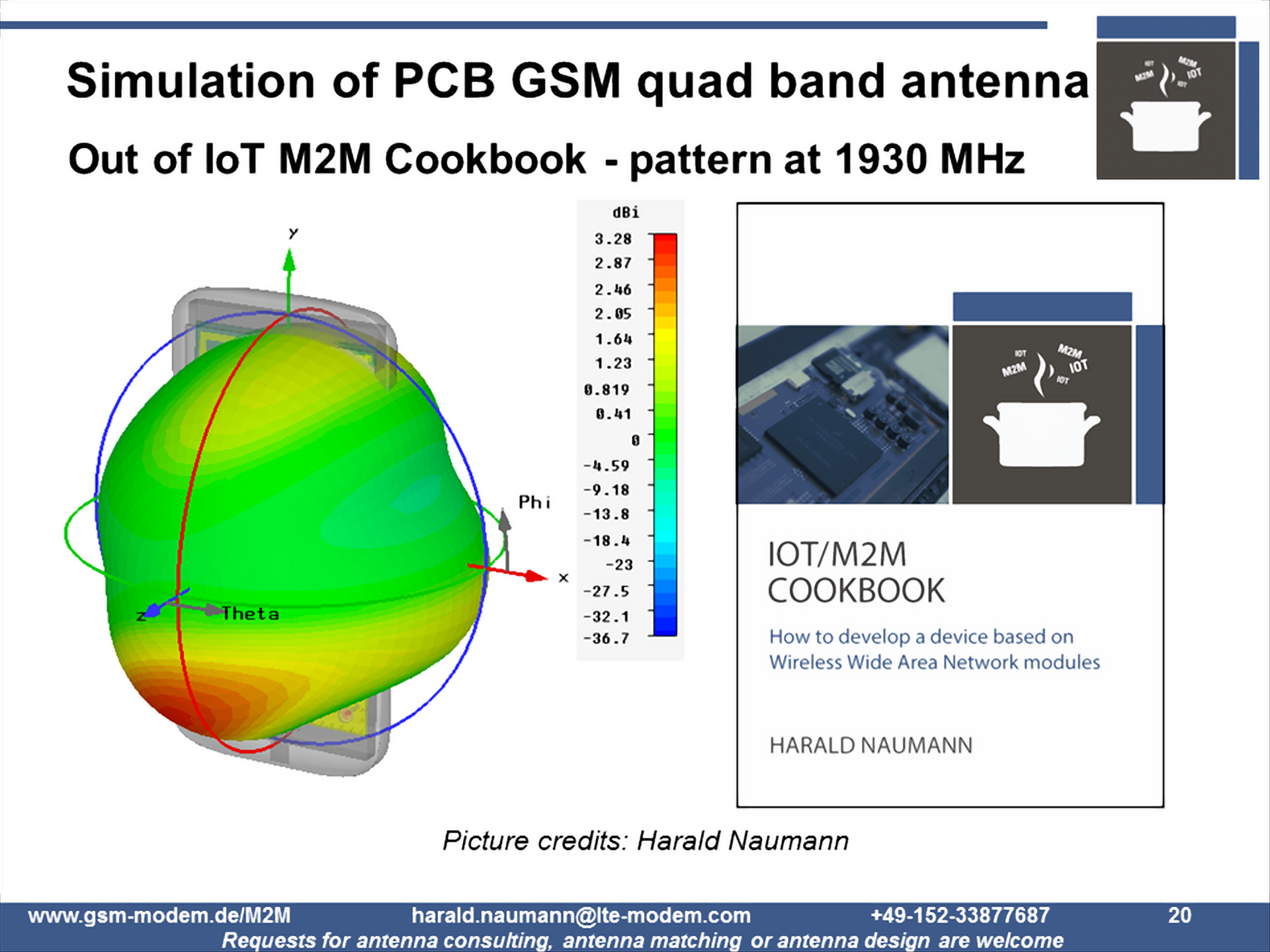
And that I know how to design in embedded GSM antennas (out of the shelf or customized) I told month ago here:
BTW, there is no out of the shelf embedded GSM antenna. You will always need some customization to create at least a matching circuit on your PCB. If somebody recommends the wrong antenna concept you cannot expect a “Porsche”. Worst case you get a “Trabant” and pay the same than for a “Porsche”.
Trabant and history of Sachsenwerke at Wikipedia
If you want a “Trabant”, then please be so kind and send no e-mail to harald.naumann (at) gsm-modem.de because I am the wrong person. I just can help with a “Porsche” with price level for a “Volkswagen” or something in between. I love to use my skills and experience to make hardware concepts on an economic price level and I have no interest to design something on low quality level. Only happy customers will help with recommendation and references.
@ Panasonic: Well done. I like your new Android Tablet
It fits perfect in a concept for tracking hunting dogs. Hunters are outside in the forest and iPads will break fast during hunting. The dog walkers that own a Husky and have to walk during heavy rain and snow will be happy with a waterproof Android smart-phone of Motorola like me. The sheep-herder will be maybe more happy with the Android smart-phone of Sony Ericsson.
And if you would like to know why I will order a Motorola Razr Droid instead a Sony Ericsson and an iPhone just send and e-mail to harald.naumann (at) gsm-modem.de, wait for the next blog posts at www.gsm-module.de or sign the RSS feeds or the email subscription.
Video about the new waterproofed Android tablet of Panasonic
Erstausgabe Wireless Telegraph
Vor wenigen Tagen wurde die Erstausgabe des Wireless Telegraph versendet. 37000 wurden gedruckt. Das Fachmagazin streicht über alle wichtigen Technologien wie z.B. NFC, Bluetooth Low Energy, GPS, Glonass, Galileo, ZigBee, 6LoWPAN, GSM, GPRS, EDGE, UMTS, HSPA, ANT+ aber auch ISM in Sub G und 2400 MHz. Selbst der neue Wifi N Standard in 2.4 GHz und 5.8 GHz wird mit industrietauglichen ICs und Modulen untermauert. Als die Entscheidung fiel das Magazin zu erarbeiten, war nicht bekannt, dass Google im Mai 2011 NFC, 6LoWPAN und Android@Home veröffentlichen wird. Das Facebook das M2M Protokoll von IBM (MQTT) anbindet war nicht vorhersehbar. Das Smartphones mit NFC und Bluetooth Low Energy in 2011 kommen werden war bekannt. In den letzten Wochen kam nun das das iPhone 4S (Bluetooth Low Energy), Motorola Razr Droid (Bluetooth Low Energy) und das Google Nexus Prime (NFC) auf den Markt. Bis Ende des Jahres werden sicherlich noch ein paar Überraschungen auf Basis Android folgen. Und bevor ich es vergesse zu erwähnen – Bluetooth Low Energy auch Bluetooth 4.0 genannt, wurde vor ein paar Tagen in Bluetooth Smart und Bluetooth Smart Ready umbenannt.
Vielleicht haben Sie auch eine Ausgabe des Wireless Telegraph erhalten. Nichtsdestotrotz, es gibt die deutsche und englische Auflage auch als Datei im Format PDF.
Mein Beitrag auf Seite 20 und 21 ist “Stromverbrauch von Ortungsgeräten”. Der Artikel zeigt die Herausforderung und Lösungsansätze für den Aufbau von energiearmen M2M-Geräten mit und ohne GPS. Das beste Konzept lässt sich oft erst vor Ort beim Kunden erarbeiten. Erst wenn Größe und Form des Gehäuses bzw. auch mögliche Gegenstände in der Nähe des Gerätes bekannt sind, kann das optimale Antennenkonzept benannt werden. Auch die Länder in welchen das Produkt benutzt werden soll, beeinflussen das Hardwarekonzept maßgeblich.
Wenn auch Sie Interesse an einer kostenfreien Beratung und ein Konzept für ein M2M-Gerät haben, dann senden Sie eine Email an harald.naumann (at) gsm-modem.de oder rufen Sie kurz an. Ich stelle Ihnen gerne meine Erfahrung (25 Jahre im Bereich Funk / 15 Jahre in GSM und GPS ) zur Verfügung. Auf Wunsch können Sie Referenzen zu drahtlosen Projekten aus dem In-und Ausland erhalten. Danke im Voraus für jede Aufgabenstellung.
First edition of Wireless Telegraph
A few days ago the first edition of the Wireless Telegraph was published. 37 000 copies were printed. The magazine relates to all important technologies such as NFC, Bluetooth low energy, GPS, Glonass, Galileo, ZigBee, 6LoWPAN, GSM, GPRS, EDGE, UMTS, HSPA, ANT + but also ISM in Sub G and 2400 MHz. Even the new WiFi N standard at 2.4 GHz and 5.8 GHz is confirmed by industry-standard ICs and modules. When the decision was made to develop the magazine it was not known that Google in May 2011 will publish NFC, 6LoWPAN and Android @ Home at I/O in California. That Facebook will attach the M2M protocol of IBM (MQTT) was not predictable. That smartphone with NFC and Bluetooth Low Energy will come in 2011 was known. In the last weeks the iPhone 4S (Bluetooth Low Energy), Motorola Razr Droid (Bluetooth Low Energy) and the Nexus Prime (NFC) were launched. By the end of the year it is determined that a few surprises on Android will follow. And before I forget to mention – Bluetooth Low Energy also named Bluetooth 4.0, was renamed to Bluetooth Smart and Bluetooth Smart Ready.
You might have gotten a copy of the Wireless Telegraph. Nevertheless, there are German and English editions in PDF format available:
Please find my article on page 20 and 21: “Power consumption of tracking devices”. The article shows the challenges and solutions for the construction of low-energy M2M devices with and without GPS. The best approach can often work out only at the customer locally. Only when the size and shape of the housing or even possible objects in the near of the unit are known, the optimal antenna design can be figured out. The countries where the product will be used will influence the hardware design significantly as well.
If you are interested in a free consultation and a concept for your M2M device, then send an email to harald.naumann (at) gsm-modem.de or give me a call at +49-1755774832. I will present you my experience (25 year in radio / 15 years in GSM and GPS). On request you can get references to wireless projects for all over the world. Thank you in advance for any challenge.
MQTT Q&A
Personal MQTT Q&A by Andy Piper
Andy contact me with the text as below. Hopefully it will bring some light in the tunnel.
“Hi, actually traffic was up by even more than that on day 2 (I’m the site admin), and there was a similar but smaller spike back in August when the Facebook news broke. Exciting times.
I’ve written up a “personal Q&A” to clarify some of the confusion circulating – partly due to a couple of articles implying that IBM and Eurotech are somehow trying to create “a whole new web”, which wasn’t actually stated in any press release that I’m aware of. Perhaps you will find it useful… I’ve also tried to round up a lot of the press and analyst coverage of the announcements at the end of the article as well.”
http://andypiper.co.uk/2011/11/04/mqtt-goes-free-a-personal-qa/
Nevertheless, if you still have further questions to M2M than just send an email to harald.naumann (at) gsm-modem.de or use the form here. I will be glad to share my more than 15 years in GSM and GPS plus 25 years in radio communication with you.
How to charge wireless?
Who can help with a proposal? Who is interested in delivering?
I have the need to make a proposal to charge the battery wireless for several project customers. We found the Wireless Power Consortium: http://en.wikipedia.org/wiki/Wireless_Power_Consortium
We emailed the Wireless Power Consortium and a few companies listed on the official website of WPC http://www.wirelesspowerconsortium.com/ but got no answer.
The idea of WPC is nice. A charger made by company A can be used to charge a device made by company B or C.
Our idea was to save time and money and not to develop a charger and to use something out of the shelf. Right now we postponed the charger and designed the prototypes without the wireless charger.
Does somebody know a company that is willing to sell a wireless charger? Does this technology maybe fit to WPC? If it fits then who will support us with the components for the charging electronic inside the waterproofed GSM/GPS tracking device?
If not, which company is able to deliver data sheets and components to design the charger and the charging electronic from scratch?
Many thanks in advance for any hint by email to harald.naumann (at) gsm-modem.de or by form .
GPS was yesterday, Glonass is today and Galileo will be tomorrow
GPS versus GPS / Glonass with option to upgrade to Galileo
- Why shall we accept an accuracy of 2.5 meter with a GPS module if we can get 1.8 meter with a combined GPS/Glonass module?
- Why shall we accept faults of hundreds of meter up to no position, if we can it high accurate even in worst case urban canyon in Dallas?
- Why to take the risk to locate or navigate on a single GPS module if you can get a double with a GPS/Glonass module that you can upgrade to a triple GPS/Glonass/Galileo module free of charge?
- What will happen with GPS during a solar flare in 2013?
- What happens if hackers tomorrow will hack the GPS satellite instead of satellites for earth climate and terrain observation like in 2007 and 2008?
Links and news related to GPS, Glonass and Galileo
- Data sheet of the new combined GPS/Glonass module with option on Galileo
- Test trip at worst case urban canyon in Dallas
- News about Solar flare at CNN
- Hackers hacked satellites at Businessweek
Why wait and not place the order for an evaluation kit today? You can choose between a small kit without gyros and MEMS and a big kit that gives you the freedom to test the Dead Reckoning. BTW, the test trip in Dallas was made without Dead Reckoning.
You are still not confident? Just have a look at:
Bye, Bye GPS – Welcome Glonass
In the video you can see the receiving of 17 satellite signals on Youtube. But this is not all. The truth is that it was in a house under the roof. The antenna showed to ground and not to sky. And to top the worst case conditions – we made the test during heavy rain (25 mm water column).
You do not believe it? Ok I go ahead:
- I can help with a video that shows the heavy rain
- I can help with the meteorological data in the test region
- I can help with contact address of people, which was in the room during the test
And if this is still not enough, then you can talk to customers of mine that have seen the new GNSS technology live during this two day business trip. The dialogue was always close the same:
“In this meeting room you will not receive a signal”
Our answer:
“You wait – please give us a minute”
The reaction
“Oh wow, can we place an order for samples and evaluation kits”
Our answer:
“Yes you can, but you have to wait for delivery”
No stock. That was the main reason not to make further noise in the tracking and navigation market. This is gone. There is stock on evaluation kits and samples for your first PCB. There are antennas that support GSM/UMTS and GPS/Glonass as well. GPS is operating on 1575 MHz and Glonass is operating on up to 1610 MHz. You will need a higher antenna bandwidth for a combination of Glonass with GPS.
Nevertheless, if you still have further questions and would like to start the development of your own GNSS application right now then just send an e-mail to harald.naumann (at) gsm-modem.de or use the form here. I will be glad to share our more than 15 years in GSM and GPS plus 25 years in radio communication with you.
.
Blogs by RSS
Email to Harald
Harald@Facebook
Harald@Google+
Harald@Linkedin
Harald´s website
M2M on Twitter