Objective: to log the movements of a customer through a retail space, for example, for market research
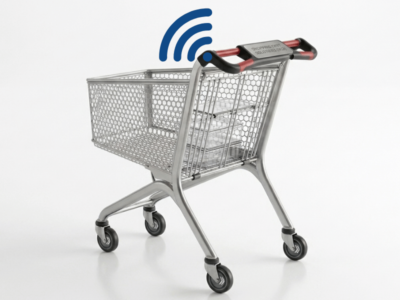
Trolley Bluetooth UWB
The objective is to log the movements of a customer within a retail space, for example, for market research purposes.
The retail environment is equipped with fixed radio beacons used for position tracking. In earlier systems, these beacons typically operated in the 2.4 GHz ISM band (2400 MHz). Each beacon periodically transmitted a signal containing a unique identifier, which could be received within a defined coverage area around the beacon.
However, the 2.4 GHz band is heavily congested and prone to interference, particularly from Bluetooth and Wi-Fi systems. This can lead to reduced reliability, packet loss, and limited positioning accuracy.
Modern systems increasingly replace this approach with Ultra-Wideband (UWB) technology. UWB transmits very short pulses across a wide frequency spectrum, making it significantly more robust against interference. In addition, UWB enables much higher positioning accuracy, typically in the decimeter range, allowing for more precise tracking of customer movements.
The core concept of the system remains unchanged:
Beacons are distributed according to the store layout, for example, in a supermarket:
-
Beacon ID001–003 in the dairy section
-
ID0004–0007 at the cheese counter
-
ID0008–0011 in the meat department
-
ID0012–0018 in wine and spirits
-
ID0019 at a promotional end-cap
-
etc.
The customer or test shopper carries a mobile data logger configured as a portable beacon, for example, as a key fob or integrated into a shopping trolley. As the shopper moves through the store, the device records all visited locations along with the time spent in each area. Passing shelves or pausing to evaluate products generates time-stamped location events, creating a sequence that shows when the shopper enters and leaves the range of each fixed beacon.
At the checkout, the complete movement log is downloaded from the mobile device and stored in chronological order in a database. All recorded paths are retained and can be accessed for analysis and reporting using SQL queries. Administrative functions include registering and managing beacon positions within the store.
The system is scalable and supports an unlimited number of fixed and mobile beacons. Due to their compact size, mobile devices can be unobtrusively integrated into shopping trolleys or handheld devices.
Integration with the store infrastructure is achieved via a radio link gateway, typically located near the checkout. This gateway collects data from mobile beacons at the end of each shopping session, transfers it to a database (e.g., MySQL) on a server, and resets the mobile devices for reuse.
An optional web or cloud interface can be provided for remote administration, monitoring, and reporting.
Available system components:
-
Fixed and mobile radio beacons (2.4 GHz or UWB, depending on system generation)
-
Radio link gateway for connection to store infrastructure
-
Database, server hardware, and optional web/cloud connectivity (pilot systems may run on a local PC)
We need a trolley tracking system
Dear Augustina,
It is a design study only. Somebudy with budget has to place an order.
Regards
Harald
Hello can i place an order
dear sir,
good day
im looking for Supermarket Trolley Tracking
I have inquiries for 250 Trolleys need to know what is the price and how is the scenarios
waiting your kind reply
I am sorry, but this product is already not available anymore.
Soory, but the product is not available anymore.