… the extension module for GSM / GPRS and GPS
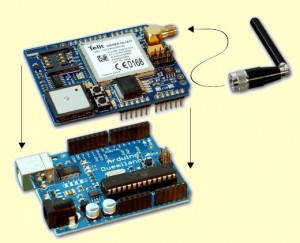
Arduino Shied with GSM and GPS module
The open-source physical computing platform Arduino, based on easily applicable hardware and software for the development of prototypes, consists of a micro controller (ATmega328) with numerous digital as well as analogue inputs and outputs and interfaces… Arduino boards can be expanded to valuable features by plugging the so-called ”Shields”. With the GSM/GPRS/GPS-Shield the Arduino board is enabled to use GSM (mobile communication) and GPS functionality (navigation), for example
- to identify the current position via GPS and send it via SMS
- send an alert
- to track a travel route and send it via GPRS
The GSM GPRS GPS-Shield is plugged as ”primary” shield on top of the Arduino board, ensuring that the antenna of the integrated GPS receiver has “free view”. The communication between the two boards is achieved via the serial interface (GSM / GPRS) and SPI (GPS). Any standard screw mount GSM antenna types (stubby, magnetic mount, adhesive mount) with SMA connectors can be used. Demo programs, drivers and libraries for operating the GSM / GPRS / GPS-Shield are of course included.
Features of Arduino GPS GSM GPRS Shield
General
- operating voltage 5VDC … 9VDC
- requires the Arduino board “Duemilanove” or “Uno”(ATmega328)
GSM
- integrated GPRS GSM module: Telit GE864-QUAD
- GSM-, GPRS-, CSD enabled
- used with pre-paid or contract SIM cards of all providers, no SIM lock
- control via serial interface (TTL level), antenna connector: SMA
GPS
- GPS module with integrated antenna
- internal supply voltage: 3,3V
- control via SPI
Arduino has a great fan community.. and of course their own website with many example applications as well as an extensive forum  → http://www.arduino.cc
Manufacturing and Product Development of the Arduino Shield “Made in Germany”, i. e. Unlike many other products in computer equipment, there is a long time availability.
Prices:
Arduino GSM /GPRS / GPS-Shield: 126,05 €
optional Arduino-Board “Duemilanove” or “Uno :22,44 €
optional GSM Antenna “AT-TG.09.0113” : 9,92 €
optional Power Supply: 8,40 €
Arduino GSM / GPRS / GPS-Shield – Kit : 158,82 €
Items in the kit:
- Arduino GSM /GPRS / GPS-Shield
- Arduino-Board “Duemilanove” or “Uno”
- GSM Antenna “AT-TG.09.0113”
- Power Supply: 8,40 €
excl. VAT. plus Postage.
More details about the Arduino GSM GPRS GPS Shield , offer or proforma invoice after sending an email
hn (at) gsm-modem.de.
Sorry to trouble again, but I would like to know how many pins are free Arduino 2009, after connecting the shield gps / gprs in order to connect a memory card to be used as a logger?
Thanks, see you soon
Alessandro
Please have a look here:
http://www.gsm-modem.de/M2M/m2m-componets/iot-avl-smart-home-aal-m2m-and-m2m2p-on-arduino/
I published a table to compare yesterday. The Arduino clone on PIC32MX320F128L has: 2-UART, 2-SPI, 2-I2C.
One UART is used for GSM module. The SPI is used for GPS (by SPI to UART converter. The smallest Arduinos has only one UART and one SPI. There is no interface left.
On PIC32MX320F128L there is one USB for Android accesory. This you can use for USB memory stick. You can run on PIC32MX320F128L the FreeRTOS and can select from this SW libraries: Android Accessory, IEEE 802.15.4 (ZigBee, MiWi, MiWi P2P), Bluetooth Stack, Ethernet (TCP-IP, Internet), USB – device & host, G.711 Speech Encoding/Decoding, ADPCM and Speex (Audio), Memory Disk Drive File System (FAT 16 and FAT32) to share and transfr data with PCs, Touch Sense (mTouch), Data EEPROM Emulation, Encryption/Decryption, nanoWatt XLP Battery Life Estimator (PIC24F), Graphics (QVGA), Helix MP3 Decoder, Certified Class B Safety, Smart card ISO-7816 and Google PowerMeter.
could anyone tell me if i’ll be able to use the shields with arduino mini pro 5v 16mhz and also could you tell me if i’ll be able to buy these in india…
thankyou
This shield is supporting 5 Volt and 3 Volt Arduinos and all clones. Most Arduino clones are on 3 Volt. So be careful by selecting shields.
hi can u give a tutorial how to operate it
Yes, as soon I have minute left. BTW, Arduinos are open source.
my GSM GPRS GPS Shield that i bought it is different from the picture in up of the page why and it has the same software ?
The new version of the shield is able to suppot 5 Volt Arduino and 3 Volt Arduino clones. The new shield is using later GSM modules and GPS modules as well.
My skills are in hardware. With software I have no experience.
the new version has no data sheet so i dont know where switch 1 and switch 2 or led 1 and led 2 and it is not operate so what can i do to operate it because my Conflict very soon
Discussion*=Conflict
What about to ask the manufacturer of the shield?
ok where can i finde him
Hello,
I have this shield but when I try to initiate the communication, the arduino print AT+CREG?.
The value return is 2 and after it’s always 0
Do you know why ?
Thank’s
Ammeenoz, you will get an email from me.
AT+CREG tells you the status of the registration. What type of GSM module is mounted on yor shield?
Is it possible to control the gsm signal the arduino uno analog outputs?
Vili, I do not understand your question. Please explain more.
Thanks, I found the answer already
Hie Vili can i get the source for the one you mentioned about controlling the arduino pins.
hi i need a library module GSM / GPS / GPRS compatible with V3.0 for Arduino Mega 2560 please help me
hi i need a library module GSM / GPS / GPRS V3.0 for Arduino Mega 2560 please
Sorry, but I am in hardware only.
Sorry, but I am in hardware mainly.